The National Alliance
and their
"Inside Source"
This article will be mainly of interest to those involved with or otherwise close to the issue of Americans missing in SEAsia. This is what's going on:
-
The National Alliance of Families is a small, powerless splinter group with 40-50 members, most of whom are not family members of missing men.
-
The Alliance publishes an occasional newsletter titled Bits 'N' Pieces; they post it on their website.
-
Beginning in the early summer of 2004, the newsletter starting carrying comments that allegedly came from and "inside source" inside DPMO.
-
The 11 September issue of the newsletter contained a long note, allegedly from the "inside source." Read it below.
-
I know the source: Daniel Warren Gray, Major, US Army (Retired). Warren was center on the University of Georgia national champion football team when Fran Tarkenton was quarterback (1960 - ?).
Warren was chief analyst for Laos when I was chief of the DIA Special Office for Prisoners and Missing. I asked a lot of Warren and he delivered every time. He never failed me -- until now. Assuming that what the Alliance reproduced are Warren's words, something has seriously clouded his judgment. Warren's comments as quoted in the newsletter are wrong, misleading, and dissembling.
Reproduced below is the Alliance 11 September newsletter with my comments inserted; the text highlighted in yellow and the [ bracketed text in red ] are my comments. The rest is copied directly from the Alliance website.
This is sad. I am concerned that, in a few months, Warren will realize what he has done and realize that he has been used by people with no morals, no ethics, and no concern for anyone else. They will toss him aside once they are finished with him.
http://www.nationalalliance.org/bits/naf2004/040911.htm
BITS 'N' PIECES
THE NEWSLETTER OF
THE
NATIONAL ALLIANCE
OF FAMILIES
FOR THE RETURN OF
AMERICA'S MISSING SERVICEMEN
+ WORLD WAR II +
KOREA + COLD WAR + VIETNAM + GULF WAR +
DOLORES ALFOND - National Chairperson
(dolores@nationalalliance.org)
425-881-1499
LYNN O'SHEA - Director of Research
(lynn@nationalalliance.org)
718-846-4350
Visit the National Alliance Of Families Home Page
August 6, 2004
Earlier this year a long time government employee [read: Daniel "Warren" Gray] involved with the POW/MIA issue resigned [actually, retired at age of about 65], leaving behind a very interesting good-bye note to the “few good people left in DPMO.” One of those “few good people” [probably a false statement intended to mislead DPMO officials; most likely Warren forwarded the good-bye note directly or through a person who agreed to act as a cut-out] forwarded the note to the National Alliance of Families, and suggested we contact the notes author.
We initiated email correspondence and met with
this individual twice, once in May and once in
June. Our email correspondence continues.
Following in the footsteps of Col. Millard Peck, Dr. Timothy Castle and others, our source has provided a laundry list of DPMO failures. His good-bye note and subsequent correspondence with the National Alliance of Families is a stinging criticism and confirms what we’ve know all along. DPMO is a failure, whose mission is to block any active and thorough investigation on our missing Servicemen. Their job is to distort, mislead and dismiss any information that would question a policy decided decades ago.!
Among the deficiencies cited in our sources “good-bye” note:
“Failure of this organization to respond to a report of live Americans in SEA;”
“Military personnel in DPMO have effectively been “reorganized” out of this military issue”
“The 185 Report”
“POWs moved from Laos to Vietnam”
“The Schederov report about Hrdlicka”
“Lao retention of a file cabinet containing POW information that we never requested”
“To approach Lao doctors who worked previously with American POWs in NE Laos”
“DPMO attitude towards Stony Beach”
While some may be familiar with the items touched on in this list, having an insiders perspective on both the information and how it was handled is extremely valuable. (Note: All information current as of May 2004.)
Based on this laundry list, we asked this individual to expand his comments and here is what we got.
[Begin] Source: DPMO has not received credible live sighting reporting that would have justified in-country investigations, although it claims that live sighting investigations are one of its priorities. [Ignores mountains of data collected during the war, decades of postwar collection from thousands of refugees from Southeast Asia, and more than 15 years of in-country investigations by American experts. Any objective analysis of the evidence can only conclude that there can be no reasonable doubt that all surviving POWs were released during Operation Homecoming in 1973.]
There are a number of reasons for the lack of reporting: there is no active effort in Thailand or anywhere else in Southeast Asia to gather live sighting information. The Stony Beach team that led that effort for years was moved from Thailand to Hawaii to be co-located with the Joint Task Force-Full Accounting (JTFFA), now JPAC, so none of the refugees in Southeast Asia are being pursued for sighting information. The situation could have been corrected had DPMO issued collection requirements to pursue the information, but it has not; as a matter of fact, DPMO has pretty much refused to use Stony Beach for any intelligence collection purposes, and that is based upon the attitude of a few supervisors in the organization. Analysts that have tried to issue collection requirements have been rebuffed by the collection representative to the extent that no active collection program is in being. During the past several years, when Stony Beach personnel approached DPMO and asked for collection requirements, the DPMO response was, “if you want collection requirements, write them yourself.” [Irrelevant carping by folks who are not willing to accept the fact that we did not leave any POWs behind. See preceding comment.]
Source: Besides the Defense Intelligence Agency (DIA), there are no other collection gathering agencies involved in the POW issue. CIA monitors the situation relative to DIA and would provide support if requested, but CIA informed DIA years ago (namely to BG Shufelt, DepDir) that DIA alone had the lead in the POW issue; this was also true relative any and all intelligence operations conducted by DIA in Southeast Asia (SEA). CIA also informed Bob Sheetz in the early 1990's that Laos and the other countries in SEA were not a priority. The only agency that might have encountered live sighting reports would have been JTF-FA during its field operations, but it would have deferred to DIA and Stony Beach for any investigation. There simply have been no credible live sighting reports for years, especially since Stony Beach was taken out of the collection issue by DPMO. [Not true. Examples: I personally know of several instances in which CIA officers surfaced leads, pursued leads, or assisted DIA to pursue leads. On many occasions DIA and DPMO linguist-analysts acted as interpreters for CIA polygraph interviews of persons offering live-sighting information. Also, FBI was active in surfacing leads and assisting DIA to follow up leads in the US. DIA and DPMO linguist-analysts interviewed many live-sighting sources jointly with FBI officers.]
Source: DPMO has no interest in using Stony Beach personnel for collection purposes, debriefings, investigations or any other type activity, and has shown that inclination time and again. [Not true. See previous comment (Ignores mountains…). Truth is that totality of evidence about the live-sighting issue eventually dictated need for changes to Stony Beach mission. Some members of Stony Beach who are stuck in the past have resisted these changes.]
In 2001, when the DIA POW/MIA Analytic Cell proposed Stony Beach operations to pursue information relative to Phou Pha Thi ( Alliance Note: Phou Pha Thi is also known as Lima Site 85) and other areas of high interest, DPMO stated it was not interested, and would not issue the collection requirements. It should be noted that for years the J2 personnel in JTF-FA, stated flatly they were not interested in using Stony Beach, and claimed that Stony Beach was doing nothing but checking up on JTF-FA, which was an absolute lie. In the early to mid-1990's DPMO leadership agreed with JTF-FA that Stony Beach would not be tasked by DPMO for operations without JTF-FA concurrence. By 1996, on-going operations came to a halt when JTF-FA refused to allow DPMO to further task Stony Beach personnel to send willing sources into countries in SEA to search for crash site, grave site and live sighting information. [At best, a dissemblance. Debriefings of survivors of the attack on the TACAN/TSQ site on Phou Pha Thi in 1968, several on site investigations by American MIA teams, extensive surveys by STONY BEACH of residents and military and civil officials in the area surrounding Phou Pha Thi, interview of several PAVN veterans of the 1968 attack, disovery of references to the attack in official PAVN histories, and the recovery of remains on the cliff below the site in 2003, leave no reasonable doubt that all 11 men lost at Phou Pha Thi were killed in action during the March 1968 attack on the TACAN/TSQ site.]
The JTF-FA bias towards Stony Beach has continued to this day since the Stony Beach personnel in Hawaii are relegated to conducting only Last Known Alive (LKA) investigations of the few remaining LKA cases. DPMO has been fully supportive of JTF -FA (now JPAC) limiting the professional interrogators and debriefers within Stony Beach to a few LKA investigations, and has made no effort to review, examine or expand the Stony Beach mission. Are the Stony Beach personnel being squeezed out of course they are. At this point in time, when the few LKA cases have been investigated, and without DPMO support, they will effectively be without a mission. (Alliance Note: We have an unconfirmed report that there were plans to move Stony Beach back to its base in Thailand. We have not heard if the move has taken place or not.) [More carping that ignores reality. It matters not where Stony Beach is located physically, nor whether it operates independently or under the JPAC, nor how dedicated, skilled, and hard working its officers might be. Stony Beach cannot discover information about that which does not and never did exist. No matter how much extremist POW/MIA activists might wish to believe otherwise, the Communists released all surviving POWs during Operation Homecoming in 1973.]
Source: In February 1993 during hearings before Congressman Dornan's committee, Dana Rohrabacher from California opined that it was his opinion that the Vietnamese kept about 200 American POWs behind as bargaining chips. That may have happened. [Nonsense. No doubt Congressman Rohrabacher's opinion is well-intentioned, but it is not supported by the mountains of information we have collected over the past 40 -- that's right, 40 -- years. No matter how much extremist activists or a well-intentioned but ill-informed Member of Congress might wish to believe otherwise, Vietnam did not keep any POWs behind after Operation Homecoming in 1973.]
In November 1993 DPMO received a report that American POWs had been held in SEA after Homecoming, possibly as late as 1976, and that the number was 185. An immediate effort was made to go back to the original source to obtain further information, without success. The report was deemed to be so important and possibly credible that the collection representative was directed to follow the situation and to conduct frequent follow-ups which did not happen.
In January 1998 members of the Joint Commission Support Directorate (JCSD) within DPMO decided to investigate the report and asked the collection representative for access. The collection representative stated that she had no idea which report they were talking about, therefore could not furnish it.
Only after JCSD personnel threatened to demand an Inspector General investigation into the loss was the report “found.” Later in 1998 JCSD did what it could with limited resources to investigate the report; that was the last action to check out the possible credible information. Details of the report have never been taken to any country within SEA to demand an explanation, perhaps because the implications of the report were that the country in question could never have been deemed to be cooperating in the POW issue if the report was true. [Note the parsing of words "possibly credible." It reflects the JCSD's own doubts about the credibility of the information in this report. Warren and the Alliance also fail to inform their readers that competent analysts made a detailed examination of the information in the cited report. No objective, knowledgeable and honest analyst can fail to conclude that the POW/MIA-related content of that report is a fabrication -- in my opinion a transparent and unsophisticated fabrication.]
The same collection representative that received the report in 1993, that lost the report in 1998 and who would have been responsible for any follow-up since its receipt, remains in place, and the report remains unresolved. During the mid-l 990's a Russian geologist was interviewed and reported that he was told in 1976 by Vietnamese counterparts that the Vietnamese Government at that time was holding live American POWs. [Hearsay. With all the well-known shortcomings of hearsay information. Fact is, there was follow-up action and it failed to find any information that would support the geologist's hearsay information. One might recall that 70 American civilians either chose to stay or became stranded in southern Vietnam when the Communists seized power in April 1975. Several of these persons were held in various prisons in southern and northern Vietnam. The last of these personswere was not released until September 1976. It is conceivable that the Russian geologist's Vietnamese source was talking about some of these American civilians and either the Russian or his Vietnamese source mistook these civilians for wartime POWs. Warren and extremist activists do not want their audience to hear about this possibility.]
Does this report substantiate the earlier reporting? No one knows since neither report has been investigated further or in-depth. [Not true that these reports were not investigated. How does one define "in-depth?" For the extremists, any investigation that results in a finding that does not support their agenda is not "in-depth."]
Source: Schederov was a Russian journalist who actively pursued the POW issue and wrote extensively as to his findings. Sometime in the late 1960's he was able to visit the caves in Viengsay, Laos where he participated in a news conference in which American POW David Hrdlicka was presented by Sisana Sisane, Minister of Information, to the reporters present. Hrdlicka was captured in 1965; Schederov never stated exactly when he was in the caves in Viengsay - some thought he was there in 1966; others thought he was there in 1968 or 1969. Schederov was brought to the attention of DPMO by Hrdlicka’s wife, Carol, (Alliance Note: Once again, a family member had to do the governments work) who on her own initiative traveled to Russia and was able to identify Schederov as a source. Schederov died before he could be interviewed on his sighting of David Hrdlicka in Laos.
JCSD made an effort to obtain further Information written by Schederov that might explain the sighting or provide other POW Information, but without success. Schederov’s information has never been presented to the Lao Government for explanation. In 1990 DIA/POW-MIA personnel identified Sisana Sisane as a valuable source for POW Information, but not until the late 1990's in the JTF-FA Oral History program was Sisana Sisane finally identified as a possible source for information on American POWs held in Viengsay. He died before he could be interviewed. JCSD was able to identify and track down two of the Russians who accompanied Schederov to Laos; one had a problem remembering anything about the trip, while the other provided detailed information that confirmed the visit. [Again, carping about moot issues. No matter how much Warren and extremist activists might protest, a preponderance of information leaves no doubt that the Lao and Vietnamese Communists governments released all surviving POWs during Operation Homecoming in 1973. The best we can hope to learn from Russian journalists or Lao and Vietnamese officials is the location of the graves of men who did not return home.]
Source: In the 1960's several Lao doctors provided medical care for the American POWs held in the caves in Viengsay, Laos. One of those doctors defected to China during the 1970's and the U.S. side asked to interview him; he reported treating a small number of Americans in the caves but he was shown no pictures and did not provide the names of any of the Americans.
After the first interview, a number of questions surfaced which justified further interview; the Chinese Government said to forget it, no more interviews. When it was determined that he was teaching at a university in Beijing, it was recommended within DPMO that he be approached. At the same time it was determined that the Lao attache to Beijing was another medical doctor who had also treated American POWs in the caves in Viengsay at the same time as the first doctor, and that both doctors were close friends.
The second doctor had never been interviewed previously as to his knowledge of American POWs. It was recommended that DPMO send a team to Beijing to interview both doctors about their experiences in Viengsay; the proposal was met with silence within DPMO. The status of both doctors is unknown at this time, and this information has never been presented to the Lao Government for explanation. [See preceding comment.]
Source: When one considers the number of reports to the effect that American POWs were transferred from Vietnam to Russia, you simply have to question whether the reporting is true or not. It makes sense that the Russians would have considered moving POWs from Vietnam to interrogate them further as to any technological expertise that was lacking in Russia. DPMO’s JCSD personnel have investigated some of these reports to an extent, but without adequate investigative resources and other support from within DPMO, have made little headway. [More dissembling and red herrings. The number of reports is relevant and significant only if one can establish that the reports are accurate, are based in fact. Although trustworthy grandmothers have been reporting for melenia that the moon is made of green cheese, it would be preposterous to conclude that the number of these reports overrides the physical evidence to the contrary that our astronauts collected from the face of the moon. Warren is well aware that their captors devoted almost no interest in eliciting technological information from our POWs. Read "Honor Bound." Warren also is well aware of the solid evidence that the Vietnamese did not permit the Russians to have direct access to our POWs in Vietnam, let alone allow them to remove POWs to the Soviet Union. If Warren wished to be honest with his audience he would describe this evidence in full and explain, if he can, why he does not believe the evidence.]
The first of these reports surfaced during the 1992 Senate Select Committee on POW /MIA Affairs hearings when the FBI provided information to the committee from one of their sources to the effect that POWs had been transferred. DIA personnel paid little attention to the report, and after the formation of DPMO in 1993, no effort was ever made to go back to the FBI source for further information.
The Russian head of the joint US - Russian commission to investigate the POW issue indicated in writing that he had seen documentation about such a transfer program; then the Russian President indicated that the transfers may have taken place. DPMO then interviewed a Russian living in Israel who stated he was told about such a program when he visited Vietnam and Laos with Russian journalist Schederov during the 1960's. [Whoever wrote this either is completely divorced from reality or is a liar. I have personally heard the Russian head of the joint commission and several key Russian members of the commission insist to their American counterparts that no American POW ever was transferred from Southeast Asia to the Soviet Union. Don't permit extremist activists to mislead you by citing the fact that a very small number of early released POWs transited the Soviet Union en route back to the United States. They were not held as POWs nor interrogated during the few hours they spent in the Soviet Union.]
Until these various reports are subjected to thorough, in-depth investigations, the collection of reporting has to be deemed compelling. Investigations into these reports have to be initiated with the governments in SEA. [End Source]
Quite a list, isn’t it!
When we were asked by Adrian Cronauer, through Ted Sampley, to provide a list of questions/topics we would like to be briefed on, we put together our list with input from our Source. Therefore it is understandable that DPMO would so far refuse to answer the eight questions submitted. [Jesus, Mary, and Joseph! Has DPMO sunk so low that its senior officers engage in any communication with Ted Sampley?!]
In looking over our sources “laundry list” we may now have the answer to one of the many questions left unanswered by the Senate Select Committee on POW/MIA Affairs. As to what is a “small number,” it may be 185.
In the interest of accurate reporting we should note that our Source told us some reporting indicates that the POWs held back were executed, their bodies cremated and buried. However, it should also be noted that our Source stated that, that portion of the story had been investigated but no evidence of could be found to support an execution or burial.
What remains is a report of 185 POWs, held back by the Vietnamese. A report that has never been fully investigated. A report whose collection representative denied its very existence, until threatened with a Inspector General investigation. Business as usual at DPMO.
So, What About the Lao Archives? Here’s what our source had to say!
[Begin] Source: Since the end of the Vietnam War, the position of the Communist Government in Laos has been that it does not hold nor has it ever held wartime archives; one reason given for the lack of records was that the Communist Pathet Lao troops were illiterate, and thus unable to prepare records. Despite mounting evidence to the contrary during the past 20 years, the U.S. Government has refused or failed to demand an accounting from the Government in Laos relative to wartime archives. Evidence that the Lao Communists do have wartime archives includes the following: [The next several paragraphs question whether we have pushed Lao authorities hard enough for access to whatever wartime documents they possess that might contain information about Americans who were lost in Laos during the war. Personally, I believe we have not. Not, as Warren suggests, because the JTF-FA/JPAC ignored the issue, but because American diplomats and politically-connected activists -- most notably during the Clinton administration -- refused to support JTF-FA/JPAC efforts to press for the documents. But, Warren and the Alliance are overstating the significance of such documents. Whatever we might have believed about those documents in the late-1970s and early-1980s, for reasons stated in my previous comments, it has been clear for many years that these documents are not going to lead us to evidence that the Loa or Vietnamese withheld POWs at the end of the war. No matter how much Warren and extremist activists might wish it was otherwise, the totality of our knowledge leaves no reasonable doubt that the Lao and Vietnamese Communists released all surviving POWs during Operation Homecoming in 1973.]
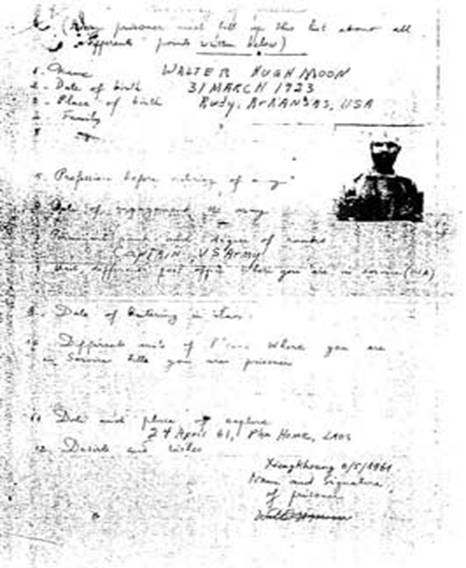
- In the early 1980’s members of the Joint Casualty Resolution Center Liaison Office in Bangkok, Thailand (to include Bill Bell, Paul Mather, et al) received a number of Xeroxed copies of a biographical document relative to Walter Hugh Moon from refugees in the Na Pho Camp, Nakhon Phanom, Thailand. (Alliance Note: During our recent meeting in Washington DC, Bill Bell brought up the case of Walter Moon, saying that information was received from a Lao Archives and never followed up on.) According to the refugee sources, several hundred similar biographical documents on American POWs were contained in the Ministry of National Defense (MND) in Vientiane, Laos. [Reported but never confirmed. Nevertheless, I believe the reports are based on fact. However, see preceding comment.] In 1985, Congressman Sarbanes [Not accurate. It was Congressman Solarz (D-NY). ] informed the Defense Intelligence Agency (DIA) POW/MIA Office that he had the original of the Moon biographical document that he had received from American Bo Gritz, and asked for analysis of the document. Although the document consisted of a single sheet of notebook paper, it was obviously the original of the copies obtained from the refugees, and it contained Moon’s signature. The original document had been cut so as to remove the date (April 1961), clearly evident on the copies, included a small picture of Walter Moon with a bandage around his head and was enclosed in plastic. The Moon family confirmed that the signature was that of Walter Hugh Moon. Gritz claimed that the document was proof that Moon was alive in captivity, albeit 20 years after his capture. At no time did the U.S. Government challenge the Lao Government regarding the document or question the fate of Moon. [I know this to be a misrepresentation of the document and the circumstances under which Gritz obtained it and under which he passed it to Congressman Solarz. Furthermore, Warren and the Alliance are being deceptive here by not informing their audience about the evidence that Captain Moon was killed during his third attempt to escape from a Lao POW camp in 1962.]
- In 1987 intelligence reporting indicated that the Lao Government in Vientiane was holding a file cabinet which contained information about American losses in Laos. Although the file cabinet in 1987 was the responsibility of the current President of Laos, the Vietnamese Government learned that the Lao had allowed access to Lao individuals who were using information from the files to search for crash sites, gravesites and the remains of Americans lost in Laos, therefore, the Vietnamese confiscated the file cabinet. The intelligence report relative the file cabinet has been declassified and a copy filed in the Library of Congress. The U.S. Government has never questioned the Lao Government about the file cabinet and the POW/MIA-related files and the whereabouts of the cabinet has been unknown since 1987. This matter was also never discussed with the Vietnamese.
- In 1987, members of an American delegation to Laos questioned the Lao point-of-contact for POW MIA Affairs, Vice Foreign Minister Soubanh, about three discrepancy cases involving Americans lost in Laos: Civilian Eugene DeBruin, USAF Captain Charles Shelton, and USAF Captain David Hrdlicka. Soubanh stated that the Lao Government would provide the U.S. side with photos of each of the men as well as death certificates. Despite the promise from the Lao side, the photos and death certificates have never been provided, and the issue was dropped shortly after 1987, never to be raised again by the U.S. side.
- In the late 1980’s American intelligence personnel had occasion to question a Lao official who had visited the United States with his family. The official was asked if the Lao Government maintained wartime archives and he admitted that it did hold archives and that a portion of the archives were stored on computers provided to the Lao Government by the U.S. In the 1990’s the Lao Government asked JTF-FA personnel to repair the hard drive on one of the computers provided by the U.S., which was accomplished. The hard drive which was replaced, which may or may not have contained wartime archives as revealed by the Lao official, was lost.
- In 1993, Lao Vice Foreign Minister Soubanh visited the U.S. and during his visit to the Pentagon was asked by COL Joe Schlatter and Civilian Fred Smith if the Lao maintained wartime archives. Soubanh stated that the Lao Government did maintain archives but he stated that the files were “incomplete.” Schlatter and Smith emphasized to Soubanh that the U.S. Government would like to have access to the archives, and Soubanh promised to look into the matter. Access to the “incomplete” archives was never requested again by the U.S. side.
- In 1993 a member of the American diplomatic corps in Bangkok, Thailand was approached by a Lao official and his assistant to discuss the POW issue relative to Laos. The Lao official admitted that the Lao government held archives and volunteered to provide specific documents from those archives. Based upon the U.S. experience 10 years earlier with the Moon document, the Lao officials were asked for documents relative to Army Captain Walter Hugh Moon, which the Lao officials again reiterated they could provide. Nevertheless, prior to their departure from Laos, the Lao officials never provided any specific archival documents relative to Americans.
- In the early 1990’s, a member of the DIA Stony Beach Team in Bangkok was able to obtain a copy of a research document prepared by the Swedish International Development Authority (SIDA), which was a complete study of Lao archives throughout the country. The purpose of the study had been to determine how the Swedish Government could assist the Lao in maintaining their archives. DIA was able to contact one of the authors of the study and asked where the Lao might be storing wartime archives. He stated that his study group had not specifically observed wartime archives, however, surmised that if the Lao held such documents, they were probably in the old American USAID Building in downtown Vientiane. At the request of the Defense Attaché Office in Thailand an individual visited the old USAID Building and asked officials there if wartime archives were stored inside; he was told that no archives were in the USAID Building, but rather were stored across the street in the National Documentation Center (NDC). The individual visited the NDC and was given a tour by the Lao custodian; although he could not discern the type of documents stored there, he did observe a large number of archives stored throughout the building. The U.S. Government never followed up on the visit and has never visited the NDC. In the early 1990’s, about the time of the Soubanh visit, Lao Foreign Minister Somsavad visited the Pentagon. The Undersecretary of Defense for Policy (USDP) met with Somsavad and asked about the SIDA study; Somsavad was unaware of the study, therefore the USDP provided Somsavad with a copy of the study and requested access to the archives identified in the document. Somsavad stated he would look into the matter. Although the Joint Task Force-Full Accounting (JTF-FA) was given access by the Lao Government to a limited number of documents, it has never gained access to the wartime archives nor visited all of the facilities named in the SIDA study as holding archives.
- It should be noted that the SIDA study identified films belonging to the Lao Government, but which were stored in Vietnam. When asked by the U.S. side for access to the films, the Lao disavowed any knowledge of the films; the Vietnamese position on the films was that the Lao Government would have to be asked before access could be granted. When a partial listing of the film titles was obtained by DIA and translated, it was obvious from the film titles alone that the films contained footage relative to American POWs. After the Lao finally admitted they owned the film, the U.S. side agreed to help return them to Laos for storage and to pay hundreds of thousands of dollars to build an air conditioned storage facility, if the U.S. side could be granted access. Despite efforts over the past 10 years to gain access to the Lao films the Lao have stubbornly refused to allow complete access to all of the films or to allow them to be copied.
- During the mid-1990’s JTF-FA personnel visited northeastern Laos, specifically Viengsay in Houa Phan Province, where the Lao admit they held American POWs during the war. The Lao have never identified the number or names of the Americans held in or near Viengsay, although the U.S. side did determine that USAF Captains Shelton and Hrdlicka were held there. Officials in Viengsay were asked by JTF-FA personnel if they held wartime archives. The Lao officials stated that wartime archives had indeed been maintained at Viengsay in the past, but that all of the documents had been moved to Vientiane. The location of the files in Vientiane was never determined by the JTF-FA personnel, and the search was not pursued in Vientiane.
- During the mid-1990’s, the JTF-FA detachment commander in Vientiane visited the Phon Kheng Lao Military Museum in Vientiane. The request to visit the museum was based upon the fact that during the early 1980’s an American visitor to the museum observed several identification and other cards of Americans lost in Laos. At that time the U.S. Government asked for immediate access to the museum which was denied; it also asked for copies of the various cards and artifacts observed on display in the museum, and that request was denied. Later the Lao Government stated that the cards and artifacts had been lost. The detachment commander asked where the Lao kept documentation regarding items on display in the museum and where other artifacts from the war might be held. The Lao escort officer stated that the documentation and items were stored at kilometer 21, just north of Vientiane. The JTF-FA commander stepped in to request access to the facility at kilometer 21, but was told that the facility there was nothing more than a truck maintenance depot, and the matter was dropped. On its own, JTF-FA personnel later visited the area of kilometer 21 and determined that the facility in question was probably located at kilometer 27; no request was ever made to visit that facility.
- In the late 1990’s JTF-FA personnel requested permission to return to Viengsay to conduct recovery operations, one of which included USAF Captain Charles Shelton. The Lao indicated that they had identified a Lao member who had participated in the burial of Shelton and JTF-FA requested access to the individual. The Lao individual revealed that the Lao Government had shown him a photo album from which he had identified the photo of Charles Shelton as the individual he helped to bury. The U.S. side asked the Lao Government for access to the photo album, and the Lao disavowed any knowledge of the album. After several months negotiating with the Lao witness, the individual accompanied JTF-FA to Viengsay to locate the gravesite. Despite its best effort, JTF-FA recovered no remains.
- In 2001 a high ranking Lao official and former member of the Central Committee left Laos under questionable circumstances. When the U.S. side talked to him in 2002 he was asked about Lao wartime archives, among many other items. He stated that the Lao Government continued to maintain wartime archives and he identified the storage facility and individuals in the Lao Government that would have access to the archives. No effort was undertaken to follow up on the archival information or any of the other information provided by the official, although the individual provided more than 22 new and important items relative to the issue of American POWs held in Laos.
These are but a few of the examples that wartime archives have been maintained in Laos since the end of the Vietnam War. [End Source]
In our letter to Mr. Cronauer, we requested a copy of the “intelligence report relative the file cabinet has been declassified and a copy filed in the Library of Congress.” We’ve had no response to that request either.
With our sources insight on it’s history and the background of the Lao archives, and their failure to produce the records it contains, it makes us wonder why the U.S. government would grant Normal Trade Relations with Laos. Perhaps, as with the Vietnamese, this is considered “full cooperation.”
Here is the one page from the Lao Archives we have on Walter Moon. We and many others have had this for years.

We’ve added a new section to our web site. It’s titled “Whistleblowers.” The new site at www.nationalalliance.org/whistleblowers/index.htm contains all the memos, letters of resignation and information provided to the National Alliance of Families, detailing years of malfeasance, misconduct and dereliction of duty by those charged with investigating the POW/MIA issue.
Here are a few quotes from the various memo’s, letters, and notes:
From Our newest source: "I am extremely disappointed regarding many aspects of the POW issue...."
From a Fax regarding the Life Science Lab: "The lab is being denied casework. This to me is a serious violation of the trust our families have put into our government to solve these cases...." (Note: this is a reference to the Life Science Lab.)
From the Castle Memo: "Unauthorized Contact With Hanoi: – “in their efforts to ensure that Hanoi's version is accepted, Mr. Destatte and Lt.Col Shiff have engaged in unauthorized contact with the Vietnamese government and Detachment 2, JTF-FA.... "
From Background Paper of I.O. Lee: "There are too many live sighting reports, specifically observations of several Caucasians in a collective farm by Romanians and the North Korean defectors' eyewitness of Americans in DPRK to dismiss that there are no American POW's in North Korea.
From testimony of former member of JTF-FA: "BG Needham.... then explained what he called his "80 percent rule." His philosophy, and consequently that of his new command, was that completing a task quickly with an 80 percent standard of success was preferable to completing it perfectly but taking more time. He emphasized that this rule was to be the guiding principle in all JTF operations, including all field investigations. "
Memo of John McCreary "Obstruction of the Investigation" – "This anticipatory discrediting of a Select Committee potential witness is tantamount to tampering with the evidence.... the Department of Defenses’ continuing access to sensitive Committee Staff papers is resulting in obstructions of the investigations by the Senate Select Committee by various agencies of the Executive Branch.
Resignation Letter of Col. Mike Peck – "The mindset to debunk is alive and well....."
Letter of Dr. Samuel Dunlap discussing deficiencies at CIL-HI – "The CID documentation you have undoubtedly seen about CILHI has led myself, my two colleagues, Drs. Lundy and Miller and several stateside forensic scientists to the inescapable conclusion that Lt. Col. Webb, Mr. Helgensen and Mr. Furue are incompetent at best..."
Why Does Johnie Webb Still Have A Job?