Khambang Sibounheuang:
MIA Dirtbag
Not all dirtbags in the MIA issue are Americans; there are folks of other nationalities who have discovered that they can gain notoriety or money off the MIA issue so they join up. Khambang Sibounheuang, a Laotian émigré living now (December 2001) near Nashville, TN, is one of these. Khambang has been the source of numerous phony stories -- and in many cases he has demanded money for information. He has no information and he's a dirtbag.
Khambang's Background
In Laos during the Vietnam War there were three major factions: the Royalists lined up behind the king of Laos; the Communists with their armed force, the Pathet Lao; and the Neutralists under "Prince" Kong Le (a former Laotian paratroop captain, Kong Le later referred to himself as "prince" although no one knew Prince of What). Khambang had been an enlisted man in Kong Le's neutralist army, achieving the rank of private first class. When he arrived in the US in 1975, he immediately promoted himself to captain. There are indications that Khambang had been asked by the Neutralists to help gain funding for their cause -- to overthrow the communist government that took over Laos in 1975.
First contact: 1985
In April 1985, Khambang approached the Defense Intelligence Agency, claiming that he wanted to talk about POWs. In a meeting with two Laotian desk officers Khambang stated that he was going to Thailand to visit his family and, if DIA would advance him $4,000, he would look for information on prisoners and missing. The DIA officers declined but told Khambang that, if he learned anything, they would welcome his sharing it with them upon his return.
In July 1985, the officers with whom Khambang had met sent him a letter stating that, since they had not heard from him, they assumed he had no information. That got Khambang rolling. He responded by claiming that he had learned about 37 Americans being held in Laos. When pressed for details, Khambang quickly got to the point: He needed money -- money for weapons, bribes, and the like. When the DIA officers refused to come up with the cash, Khambang went off to more fertile fields.
"Mr. Roly/Howard Stephenson" Emerges
At this time, Khambang was working as a security guard in Nashville. He met an individual named Frank Lockhart, an electronics salesman who claimed to have a Ph.D. in psychology. Khambang fed Lockhart stories about his exploits and about US POWs held in caves in Laos.
At the same time, Khambang was feeding the same line of crap to two Americans, Lance Trimmer and Gordon Wilson who were working with "Bo" Gritz. Khambang gave them a number of stories about US POWs held in the middle of Hanoi and in remote mountain caves in Laos. Meanwhile, Gritz had not told Trimmer and Wilson that he was working with Kong Le. Learning the Khambang was an associate of Kong Le, Trimmer and Wilson asked for a meeting with Kong Le. A meeting was set up in Paris -- Kong Le thought Trimmer and Wilson were government agents who had been authorized to work with the Neutralists -- and Trimmer and Wilson bought Khambang a plane ticket. While in France, Khambang arranged to have a photo of an American POW provided to him -- it never appeared so everyone went back home.
Later, Khambang surfaced the promised photo. It showed a skinny, bearded, shaggy-haired man with somewhat Caucasian features, clad only in long, dark trousers. Khambang identified him as "Mr. Roly." Lockhart jumped into the affair and sent the photo to former Navy Captain and ex-POW "Red" McDaniel, himself the perpetrator of a number of phony stories. Lockhart, using a list of names of missing men, claimed that the man in the photo was USAF LTC Charles Rowley who had been shot down over Laos in 1970. He based this "identification" on the fact the "Roly" sounded like "Rowley." Meanwhile, DIA identified the photo as one that had been turned in earlier by another source who claimed it was missing American Howard Stephenson -- although the source identified him a "Phenson." Stephenson and Rowley family members stated that the photo bore no resemblance to their missing man and DIA felt the photo had come from a propaganda movie.
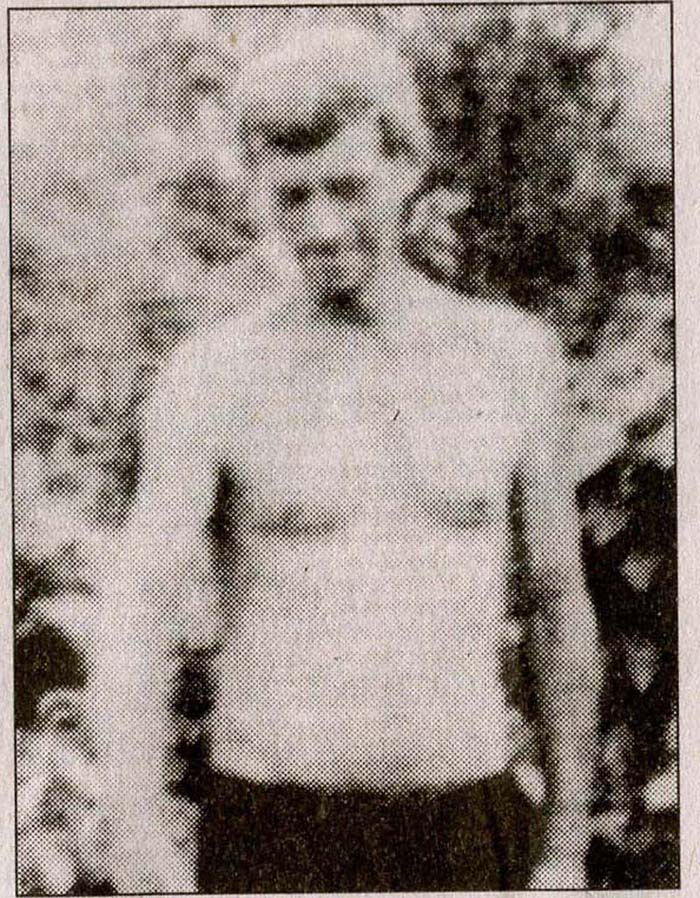
This photo has surfaced time and again, mainly from individuals trying to convince us that they have information about live US POW's. People with the photo have claimed it is "Mr. Roly," "Mr. Phenson," and other names that resemble the names of missing Americans. It is not a photo of any missing American, though we never determined who this really is.
Lockhart and Khambang were not satisfied so they sold the photo to Life magazine who printed the phony picture as part of a special POW-MIA issue. All this so embarrassed and angered Kong Le that he fired Khambang and told him to have nothing to do with the Neutralist organization. Khambang did not bother to tell anyone else about this -- he continued to represent himself as the successor to his "uncle," Kong Le.
Khambang is Promoted to Colonel
By late 1989 Khambang had moved to Arlington, Virginia, where he was working as a clerk in the police department. He contacted author Susan Katz-Keating who, at the time, was working on her book Prisoners of Hope. He attempted to interest her in some information, claiming that she could trust him because he was an Arlington police officer. When she told him that she knew an Arlington police officer, Khambang hung up and had no further contact.
DIA was approached by members of a local American Legion post who told quite a tale. It seems they had been approached by a "colonel in the Lao resistance" who told them that he and his organization knew the whereabouts of two Americans being held in a cave in Laos. The two men were to take $10,000 each and go to Thailand where they would meet resistance contacts -- the group would then go into Laos and rescue the Americans. At the same time, a Washington Times photographer was approached by the same Legionnaires with the same story. They took him to a meeting with the "colonel" -- who turned out to be Khambang.
In the presence of the photographer -- who tape recorded the conversation -- Khambang called a friend of his in Thailand and told the friend that he needed information on "the Americans." The friend in Thailand had not a clue what Khambang was talking about but, after Khambang repeatedly asked for information "about the Americans," the guy caught on and promised to send information. Shortly thereafter, Khambang passed to the photographer a cassette tape. At the same time, the same tape was provided to DIA by other sources in Thailand. There is a voice on the tape of an individual claiming to be an American who asks that he be rescued. The problem is, the voice clearly is not that of a native English speaker, much of the tape makes no sense, and the recording -- supposedly made deep in a jungle cave -- has children laughing and squealing in the background and at one point a helicopter flies overhead.
The legionnaires were convinced that Khambang was a scam artist, the Washington Times photographer had recognized that fact long ago, and Khambang was dropped.
Never fear, though -- Khambang moved to Nashville where he went to work as a bailiff for Judge Hamilton Gayden -- Khambang and Gayden were to surface more nonsense, only this time under the cover of Gayden's judicial robes.
Summer 1991
As I have descried in the article on events of 1991, Khambang and his judge friend were part of a bigger scam.
In the summer of 1991, a photo surfaced of a balding, dark complexioned man sitting in a wooded area. MIA parents Dan and Betty Borah claimed that the man was their son, USN Lieutenant Daniel Borah, shot down over Vietnam in 1972.
The Borah photograph was found to be a picture of a seventy-year-old man from a Laotian hill tribe; his name was Ahroe, he lived in Muang Nong, Laos, and he was French-Laotian. He had been photographed by a Laotian refugee who gave some copies of his photographs to a friend who gave them to -- you guessed it -- Khambang Sibounheuang, a Laotian émigré living in Nashville, TN.
Khambang had shown the photos to his boss, Hamilton Gayden. Gayden looked through a Life magazine article on POWs until he found a "match" and declared that this was a photo of Borah. Gayden withheld the photos from DIA and contacted the Borah family who "positively identified" the photo. The family called Senator Bob Smith for guidance. DIA contacted Smith and asked for copies of the photo. Smith refused. Then, Smith and Mr. Borah appeared on the Today show where Smith -- get this -- accused DIA of trying to suppress the photo!! (How does DIA suppress what they do not even have?)
Later , the Borah family went to Laos and met Ahroe who confirmed that he was the man in the photo. Ahroe was fingerprinted and photographed to prove that he was not a brainwashed Borah. Still, the "Borah" photo is an article of faith among the MIA faithful. Follow this link to see the phony photo.
( Footnote: Borah was shot down in September 1972. His wingman observed him eject with a good chute; Borah made one transmission on his survival radio in which he said he was surrounded by enemy soldiers; he was never heard from again. Shortly after the shootdown, US forces observed enemy troops removing Borah's parachute from a tree. In 1996, DIA researchers located an eyewitness who described the burial of a dead American at a location that matched Borah's loss. A search of the are found a gravesite that was excavated. A badly-eroded human skeleton, 19 teeth, and fragments of flight suit and survival gear were found in the grave. The remains were identified as those of Borah. )
Ten years later
This article is being prepared in December 1991 -- a decade after the events of 1991. The MIA issue has all but disappeared from the US press, surfacing only when remains are returned an identified. US personnel are stationed in Hanoi, Vientiane, and Phnom Phen where they conduct searches, interviews of eyewitness, and document research in archives -- all to find information that will lead to recovery of the remains of missing Americans.
The Khambang Sibounheuangs and Hamilton Gaydens have disappeared -- or have they? In late November 2001, I received a series of e-mail messages from an individual claiming to know Khambang. He told me what a great guy Khambang is, how he knows the Borah photos are real, how Khambang was not treated properly by DIA and the Senate Select Committee, yadda, yadda. I suppose even a dirtbag needs a friend.
Date prepared: December 2001